ACT to SAT Conversion
Enter a composite score below and this ACT to SAT conversion tool matches it to the equivalent score on the other scale, using the same concordance data colleges rely on. Switch the toggle to run a sat to act conversion instead, going the opposite direction.
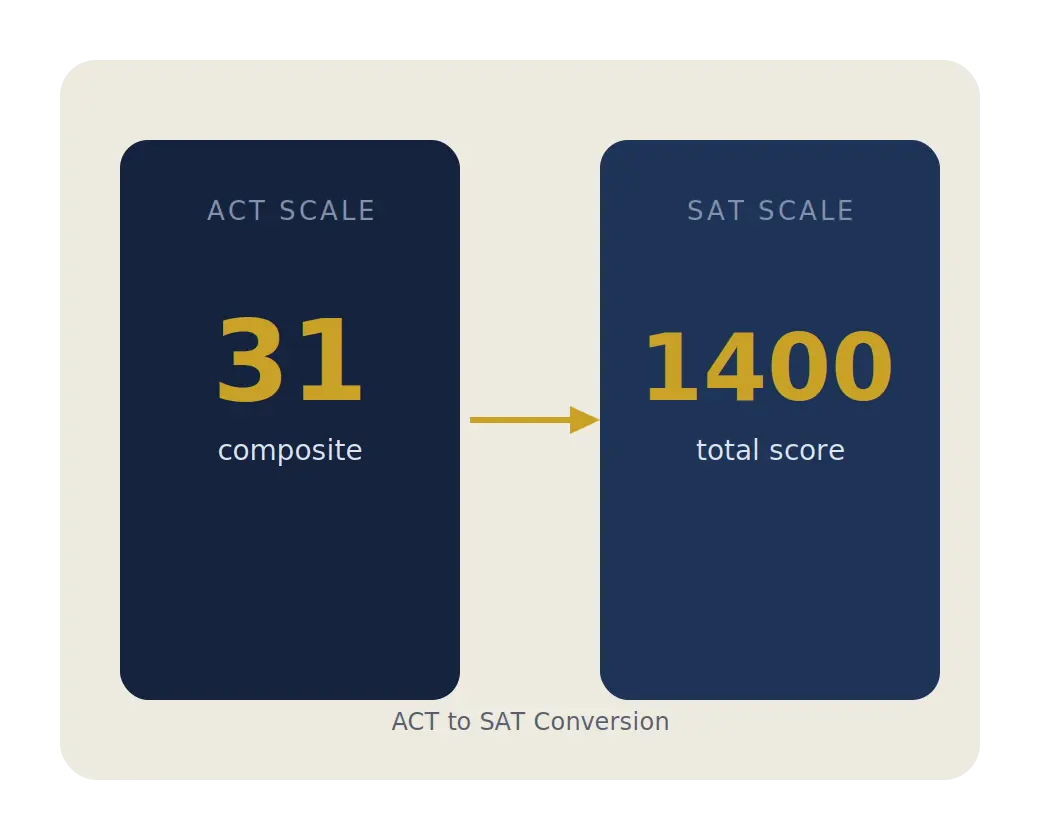
This act to sat conversion uses the officially published concordance table. Individual test forms can shift results by a small margin, so treat this as a close estimate.
How This ACT to SAT Conversion Chart Was Built
Every act to sat conversion table in circulation traces back to the same source: a joint concordance study run by the two testing organizations, which compared how the same group of students performed across both exams and matched their percentile ranks between the two scales.
That's different from a formula-based estimate. It's an empirical mapping built from real test-taker data, which is why the same act to sat conversion numbers show up across most reputable college-planning resources rather than varying wildly from one site to the next.
Percentile matching means a score that beats 92 percent of ACT test takers is lined up with the SAT score that beats roughly 92 percent of SAT test takers, even though the two exams differ in format, timing, and question style. It's a fair way to compare two different scales without pretending the exams are interchangeable question for question.
Where the Two Tests Actually Differ
An act to sat conversion works because the tests measure overlapping skills, not because they're built the same way. The ACT includes a dedicated Science section built around graphs and data sets, something the SAT doesn't have at all. The SAT, in turn, splits its math portion into a calculator and a no-calculator section, while every ACT math question allows a calculator throughout.
Timing differs too: the ACT gives you less time per question on average, which is why students who describe themselves as fast readers under pressure often score better on the ACT relative to their SAT performance, and the conversion table reflects that pattern across large groups of test takers even though it can't predict any one individual's experience.
None of that means one test is easier than the other in general. It means the format rewards slightly different strengths, which is exactly why running your numbers through the calculator above, in either direction, is worth doing before committing to a retest on either exam.
The Full ACT to SAT Conversion Table
Scroll the table to see where every ACT composite score from 1 to 36 lines up on the SAT's 400 to 1600 scale. This same data powers the calculator above, so the two will always match.
| ACT Composite | SAT Total |
|---|---|
| 36 | 1590 |
| 35 | 1540 |
| 34 | 1500 |
| 33 | 1460 |
| 32 | 1430 |
| 31 | 1400 |
| 30 | 1370 |
| 29 | 1340 |
| 28 | 1310 |
| 27 | 1280 |
| 26 | 1240 |
| 25 | 1210 |
| 24 | 1180 |
| 23 | 1140 |
| 22 | 1110 |
| 21 | 1080 |
| 20 | 1040 |
| 19 | 1010 |
| 18 | 980 |
| 17 | 950 |
| 16 | 910 |
| 15 | 880 |
| 14 | 830 |
| 13 | 780 |
| 12 | 730 |
| 11 | 690 |
| 10 | 650 |
| 9 | 620 |
| 8 | 590 |
| 7 | 560 |
| 6 | 530 |
| 5 | 500 |
| 4 | 470 |
| 3 | 440 |
| 2 | 410 |
| 1 | 400 |

Running a Sat to Act Conversion in Reverse
Flip the toggle above and the same tool runs a sat to act conversion instead, taking your SAT total and returning the closest matching ACT composite. This direction gets used just as often as the standard act to sat conversion, especially by students who started SAT prep first and later want to know whether switching tests might play more to their strengths.
One thing worth knowing about this reverse direction specifically: because both scales group scores into ranges rather than a perfect one-to-one line, converting from SAT to ACT and then back to SAT again can sometimes land you a few points off from where you began. That's not a bug in the math, it's just a natural side effect of matching two different scoring systems by percentile band instead of a single formula.
A Few Common Score Comparisons
Students researching a specific target often want to see one number lined up against another rather than scrolling a full table. A 34 act to sat comparison lands right around 1500, which sits near the 99th percentile on both scales. A 31 act to sat comparison lands close to 1400, solidly in range for most flagship state universities. Lower down, a 24 act to sat comparison sits close to 1180, right around the national average on both tests.
Want your ACT composite calculated first?
Run your raw section scores through the calculator to get a composite before converting it here.
Why Colleges Look at Both Scales
Most admissions offices review applicants side by side regardless of which test they took, and an act to sat conversion chart is exactly what makes that comparison possible. A reader evaluating one file with a 29 ACT and another with a 1340 SAT isn't guessing whether those are roughly equivalent, they're pulling from the same concordance data available here.
That matters most for merit scholarships and honors programs, where cutoffs are often published for one test and need to be translated for students who submitted the other.
It also matters for superscoring. ACT superscoring combines your best section scores across different test dates on the same exam, and SAT superscoring works in a similar way on its own separate scale, but colleges do not combine a superscored ACT with a superscored SAT into a single blended number. If you've taken both tests, most schools will still evaluate each superscore independently and consider whichever one is stronger.
Deciding Whether to Switch Tests
If you've only sat for one exam, a rough act to sat conversion still helps, even without an actual second score to compare. Take an official practice test for the other exam under timed conditions, convert your ACT composite using the table above, and see how the practice result compares. A meaningful gap, more than a couple of points on the converted scale, usually points toward whichever test format suits you better, and it's a far cheaper way to find out than registering for an official retest on the wrong exam.
Keep in mind that switching tests close to application deadlines carries its own cost in prep time, so this kind of comparison is most useful early, ideally before junior year spring, when there's still room to commit fully to whichever test the numbers favor.
Common Questions About ACT to SAT Conversion
How accurate is an ACT to SAT conversion?
It's accurate as a percentile match rather than an exact content match. The two exams test overlapping but different skills in different formats, so an act to sat conversion tells you where a score ranks nationally, not that the two scores measure identical abilities question for question.
Do colleges actually use ACT to SAT conversion charts?
Yes. Most admissions offices reference an official concordance table to compare applicants who submitted different tests, so they aren't guessing when they place a 32 ACT next to a 1430 SAT on the same shortlist.
Is a sat to act conversion the exact reverse of an act to sat conversion?
Close, but not always a perfect mirror. Because both scales group scores into ranges rather than a strict one-to-one match, converting SAT to ACT and then back to SAT can sometimes land a few points off from where you started. Treat either direction as a close estimate rather than an exact inverse.
Which test should I focus on if my scores convert unevenly?
Focus on whichever test your converted score favors, since that usually signals the format suits you better. A student whose SAT converts higher than their ACT composite is often better off spending remaining prep time on the SAT, and the reverse holds just as true.
Does superscoring work the same way across both tests?
Not exactly. ACT superscoring combines your best section scores across test dates on the same exam, while SAT superscoring works similarly but stays on its own separate scale. Colleges don't merge a superscored ACT with a superscored SAT into one blended number.
A Note on Accuracy
This act to sat conversion tool uses officially published concordance data rather than a guessed or invented formula, which is the same standard most college-planning resources hold themselves to. Even so, treat any conversion as a planning estimate rather than a guaranteed substitute score.
Admissions offices, scholarship committees, and testing policies can each apply concordance data slightly differently, so if a specific cutoff matters for an application, confirm how that particular school or program handles converted scores before assuming this chart settles the question. For the raw score math behind your ACT composite itself, see the ACT score chart, or head back to the ACT score calculator to work out your composite from scratch.