ACT Score Calculator
Type in your raw scores for English, Math, Reading, and Science, and this ACT score calculator converts them into your scaled composite score in seconds.
It's the same math the testing service uses, minus the wait for a mailed report.
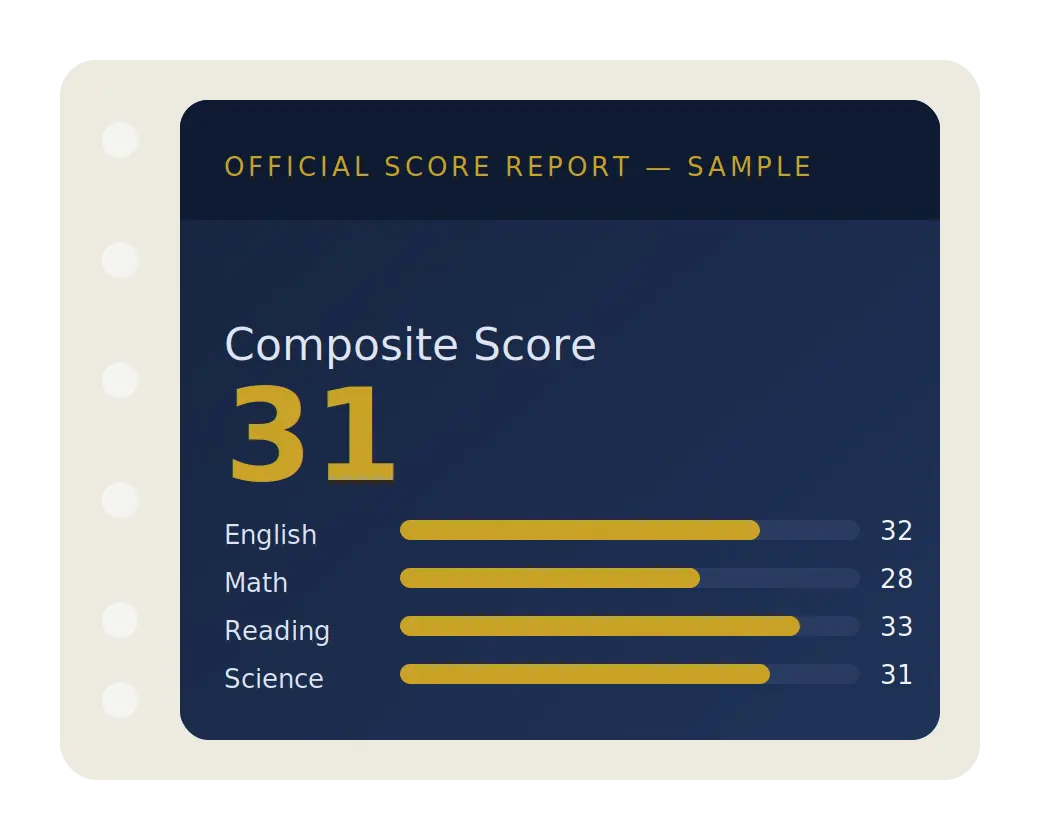
This ACT score calculator estimates your scaled scores using a typical raw to scale conversion curve. Your official result on test day may shift by a point per section, since every form is curved on its own.
How This ACT Score Calculator Converts Raw Scores
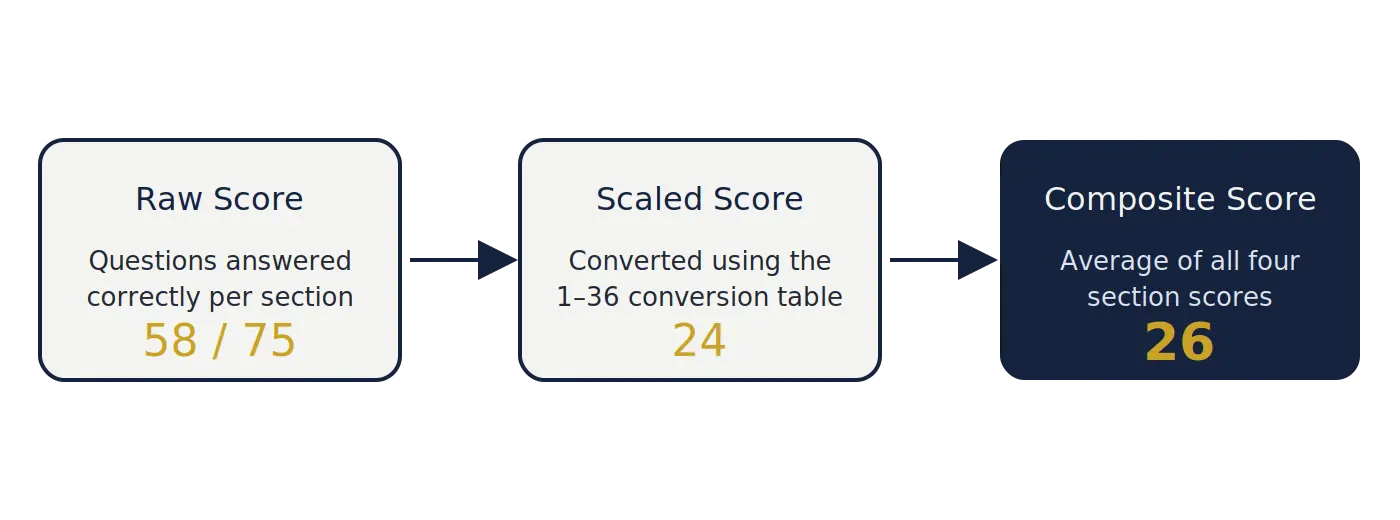
Every ACT score calculator, this one included, starts from the same place: your raw score, meaning the number of questions you answered correctly in each of the four multiple choice sections. The testing service converts that raw score into a scaled score between 1 and 36 using a conversion table that shifts slightly from one test form to the next.
That's why two students who miss the same number of questions on different test dates can end up with different scaled scores for the same section, even though they made the exact same number of mistakes.
Once all four scaled scores are set, your composite score is simply the average of the four, rounded to the nearest whole number rather than truncated down. A composite of 27.5 rounds up to 28, not down to 27. That single number is what admissions offices see first on your score report, and it's the number this ACT score calculator is built to estimate as closely as a general conversion curve allows.
People search for this tool under a handful of different names. Some type "ACT calculator," others look for an "ACT test calculator" right after a practice exam, and a fair number just search "ACT score calc" out of habit, the way you'd shorten any tool name you use often. They're all asking for the same thing: a fast way to turn raw answers into a real composite score without pulling out a calculator and a printed conversion chart.
The Four Sections, Briefly
English gives you 75 questions in 45 minutes, mostly grammar, usage, and rhetorical skills questions tied to five passages. Math runs 60 questions in 60 minutes, covering everything from pre-algebra through trigonometry, with no formula sheet provided.
Reading is 40 questions in 35 minutes across four passages, testing how well you can locate and interpret information under time pressure rather than deep literary analysis. Science, despite the name, tests data interpretation more than memorized facts: 40 questions in 35 minutes built around graphs, tables, and short experiment summaries.
Each section gets its own 1 to 36 scaled score before the four are averaged into your composite.
Reading the Report Card Above
Move the sliders to match how many questions you got right on a practice test or an old exam, and the composite panel updates instantly. There's no submit button because there's nothing to wait on: the calculator recalculates on every keystroke, so you can test what a few extra correct answers in Math versus Reading would actually do to your average before you decide where to spend your next study session.
If you're checking a full practice exam, this doubles as an ACT test calculator. Run each section's raw score through once, and you'll see your estimated composite before any answer key spreadsheet would give you the same number. It's also useful for the opposite question: if you already know your target composite, you can slide the sections around until you find a combination that reaches it, which tells you roughly how many more questions per section you need to be getting right.
What Counts as a Good Score
"Good" depends entirely on where you're applying, and honestly, that's the most useful thing anyone can tell you about ACT scores. A composite around 20 sits just above the national average, a 24 clears the bar at most public state universities, and a 30 or higher moves you into range for selective private schools.
None of those numbers mean anything on their own until you hold them up against where you actually want to go. Rather than guessing where you land, run your numbers through the ACT score calculator above, then compare the result against the national percentile data below.
| Composite | Approx. National Percentile | Typical Fit |
|---|---|---|
| 34–36 | 99th | Most selective private universities |
| 30–33 | 93rd–98th | Highly selective schools, honors programs |
| 27–29 | 85th–92nd | Competitive public flagships |
| 24–26 | 74th–84th | Most public state universities |
| 20–23 | 50th–66th | Open and moderately selective admission |
| Below 20 | Under 50th | Open-admission colleges, community colleges |
Composite Score Versus Section Scores
Admissions readers usually look at your composite first, but they don't stop there, especially if you're applying to a program tied to a specific subject. An engineering program will notice a strong Math and Science score even if your composite sits a point or two below their published average.
A journalism or English program pays more attention to English and Reading. If your section scores are uneven, that unevenness can actually work in your favor depending on where you're applying, which is another reason it's worth checking your section breakdown here rather than only tracking the single composite number.
Applying with scores from more than one test date also changes the picture. Colleges that superscore will take your best section scores across attempts rather than your best single day composite, which means a strong Math score from March and a strong Reading score from June can combine into a superscore higher than either test date produced on its own.
It's worth checking each school's policy before deciding whether a retest is worth the time and the fee.
Comparing scores against the SAT?
See exactly what your composite equals on the SAT's 400–1600 scale using the official concordance table.
Common Questions About This ACT Score Calculator
Is this ACT score calculator actually accurate?
This ACT score calculator uses the same composite averaging method the testing organization has used for years: your four section scaled scores are averaged and rounded to the nearest whole number. The raw to scale conversion itself is an estimate built from a typical test form curve, since the official table shifts by a point or two from one test date to the next. Treat the result as a close estimate rather than a guaranteed official score.
How is this different from a normal ACT calculator?
Most tools labeled as an ACT calculator only total your composite and stop there. This one also shows your estimated scaled score for each section as you type, so you can see which section is actually pulling your average up or down before you decide what to study next.
Can I use this as an ACT test calculator before test day?
Yes. Plenty of students use this ACT test calculator right after finishing a timed practice exam, entering the number correct per section straight from an answer key to get an estimated composite while it's still fresh in their mind, well before an official score would post.
What is an ACT score calc, exactly?
An ACT score calc is just shorthand for the same kind of tool, one that turns your raw answers correct count into your official 1 to 36 composite score without you having to look up a conversion table by hand.
Does this include an ACT test score calculator for the optional writing test?
No, and neither does your composite. The optional writing test is scored separately on a 2 to 12 scale and doesn't factor into your composite at all, so this ACT test score calculator focuses only on the four multiple choice sections that make up your main score.
Why do so many students search for an ACT score calc instead of doing the math themselves?
Because the raw to scaled conversion table changes slightly by test form, and digging through a PDF answer key to find the right curve takes longer than moving four sliders. A tool that's kept current just saves that step.
How many questions are on each section of the ACT?
English has 75 questions in 45 minutes, Math has 60 questions in 60 minutes, Reading has 40 questions in 35 minutes, and Science has 40 questions in 35 minutes. Each section produces its own scaled score before the four are averaged into your composite.
Where This Fits in Your ACT Prep
A calculator only tells you where you stand right now, not how to move the number, and it's worth being honest about that limit up front. If English is your weakest section, that's usually a grammar rules problem you can fix with targeted drilling rather than more timed practice tests.
If Science is dragging your composite down, it's rarely about science knowledge at all; it's almost always a pacing problem across the seven passages, since most students who run out of time on Science actually understand the content just fine.
Come back to this ACT score calculator after each practice test to track whether those fixes are actually working, section by section, rather than waiting for a single composite number to tell the whole story weeks later.
For the full raw to scale breakdown by section, see the ACT score chart, or read through how ACT scoring works for the mechanics behind the curve, including why the same raw score can land differently depending on the test date.
A Few Honest Limitations
This ACT score calculator is built to be genuinely useful, not to oversell what a raw to scale conversion tool can actually promise. The official conversion table is set individually for each test form, based on how that particular group of test takers performed, which is a process the testing organization doesn't publish in full detail ahead of time.
What you get here is a well-informed estimate based on typical curves seen across many past test forms, not a guarantee that matches your exact test date down to the point.
In practice, that estimate tends to land within a point of your actual scaled score per section for most raw score ranges, which is usually close enough to plan your study time around. But if you're right on the edge of a scholarship cutoff or an admissions threshold, treat the number here as a strong guide rather than the final word, and confirm anything that matters with your official score report once it arrives.