How ACT Scoring Works
ACT scoring can feel like a black box until you see the actual mechanics behind it. This guide walks through raw scores, the 1-36 scale, composite averaging, and percentiles, so you know exactly what's happening between the test you take and the number that shows up on your report.
The Building Block: Your Raw Score
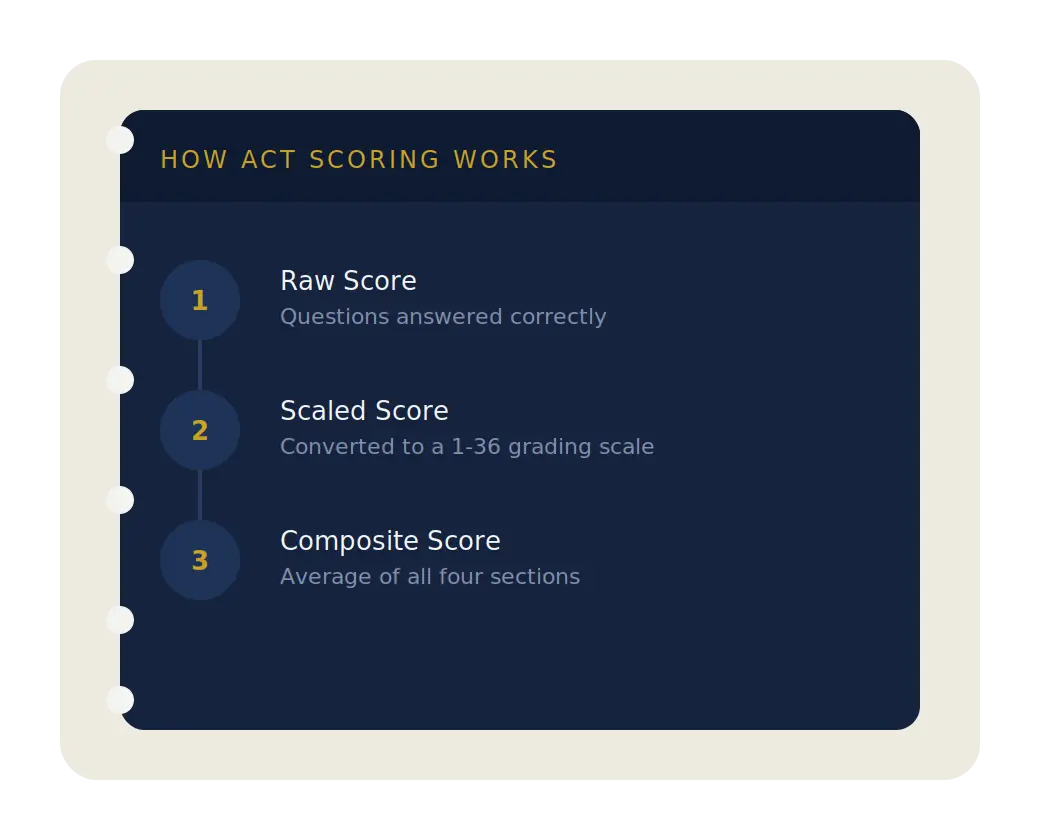
ACT scoring starts with something simple: how many questions you answered correctly in each section. This is your raw score, and it's the only input that matters at this stage. There's no penalty for a wrong answer built into ACT scoring, so a question you miss and a question you skip entirely cost you exactly the same thing, nothing extra is subtracted for guessing incorrectly.
That single rule shapes test-taking strategy more than almost anything else, since it means guessing on a question you're unsure about can only help or leave your raw score unchanged, never hurt it.
Each section has a different number of questions. English has 75, Math has 60, and Reading and Science each have 40. Your raw score for a section is simply the count of correct answers out of that total, nothing more complicated than that.
Converting Raw Scores on the ACT Grading Scale
Here's where ACT scoring gets more interesting. Your raw score doesn't get reported directly. Instead, it's converted onto this 1 to 36 scale, a range that every section, and your eventual composite, is expressed on. This conversion isn't a simple percentage.
A raw score of 60 out of 75 on English doesn't automatically mean a scaled score of 24, because the scale is built from how an entire group of test takers performed on that specific version of the exam, not from a fixed formula applied the same way every time.
This process is called equating, and it exists to keep the grading scale fair across different test dates. If one test form happens to be a little tougher than another, the raw score needed to reach a given scaled score drops slightly to compensate, so a 28 earned in September and a 28 earned in April represent roughly the same level of performance nationally, even if the exact questions and difficulty differed.
How Your Composite Score Gets Calculated
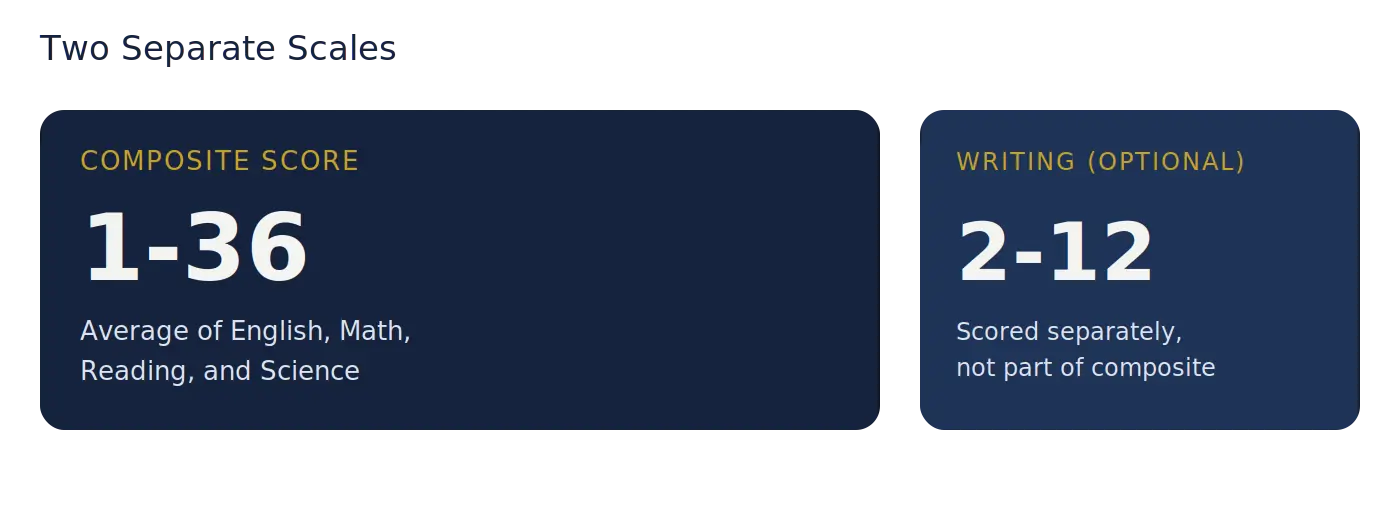
Once all four sections have a scaled score on the 1 to 36 scale, ACT scoring finishes with one last step: averaging. Your composite is the mean of your four section scores, English, Math, Reading, and Science, rounded to the nearest whole number rather than truncated. A set of scaled scores like 30, 26, 29, and 27 averages to 28, and that rounded average is the single number that shows up first on your score report and on most college applications.
It's worth noticing that this averaging step means a weak section doesn't sink your composite as much as students often fear, especially if the other three sections are strong. A single low section gets diluted across four numbers rather than standing alone, which is one reason targeted improvement in your weakest area tends to move the composite more efficiently than trying to improve everything at once.
A Quick Worked Example
Say a student answers 62 out of 75 correctly on English, 44 out of 60 on Math, 32 out of 40 on Reading, and 29 out of 40 on Science. Running those raw scores through the conversion chart for a typical test form gives scaled scores of roughly 26, 25, 29, and 26. Averaged together, that's 26.5, which rounds up to a composite of 27. Every step of ACT scoring, from raw answers to a final report, follows that same path.
Want to see this math done for your own scores?
Enter your raw section scores into the live calculator and get your estimated composite instantly.
What Percentiles Mean in ACT Scoring
Alongside your composite, your score report includes a percentile rank, and this is a part of ACT scoring that often gets misunderstood. A percentile doesn't measure how many questions you got right. It measures how your composite compares to other test takers nationally. A percentile of 75 means your score matched or beat about 75 percent of everyone else who took the test in the comparison group, not that you answered 75 percent of questions correctly.
| Composite | Approx. National Percentile |
|---|---|
| 34-36 | 99th |
| 30-33 | 93rd-98th |
| 27-29 | 85th-92nd |
| 24-26 | 74th-84th |
| 20-23 | 50th-66th |
| Below 20 | Under 50th |
This is also why the scale isn't linear in terms of difficulty. Moving from a 20 to a 23 might require a modest jump in raw scores, but moving from a 33 to a 36 usually demands near-perfect performance, since so few test takers reach that top band that each additional point represents a much smaller slice of the population.
The Optional Writing Test: A Separate System Entirely
Students sometimes assume the optional writing test factors into ACT scoring for the composite, but it doesn't. Writing is scored on its own 2 to 12 scale by two independent readers, using entirely different criteria than the multiple choice sections. That score is reported separately and never blends into your 1 to 36 composite, no matter how well or poorly you did on the essay itself. Not every college requires it, so it's worth checking application requirements before assuming you need to sit for it at all.
How Superscoring Fits Into ACT Scoring
If you test more than once, many colleges will superscore your results, taking your best scaled score in each section across different test dates and recombining them into a new, often higher, composite. This doesn't change how ACT scoring works on any single test day, it just changes how your results get combined afterward. Not every school superscores, so it's worth checking each college's policy individually rather than assuming it applies everywhere.
What Actually Shows Up on Your Score Report
Once ACT scoring finishes processing your test, the report you or your school receives includes more than just the composite. You'll see your four individual section scores, the composite average, a national percentile for each of those numbers, and if you sat for it, a separate writing score with its own percentile.
Many reports also break section scores down further into subscores covering specific skill areas, like usage and mechanics within English, though colleges rarely weigh subscores heavily in admissions decisions the way they do the composite.
Score reports also list every test date on file if you've tested more than once, which matters because some colleges want to see your full testing history rather than just your highest attempt. It's worth checking a school's specific score-reporting policy early, since a handful of colleges do request all scores rather than allowing you to send only your best sitting.
Why Two Students Can Answer the Same Number Right and Score Differently
This trips up a lot of students who compare notes after a test date. Because ACT scoring runs each section's raw score through a curve specific to that exact test form, two students who took different versions of the ACT, even on the same day at different testing centers, can miss the identical number of questions and still land a point or two apart on their scaled score. It isn't a mistake or an inconsistency in ACT scoring, it's simply two separate curves doing their job, each calibrated to its own group of test takers.
Common Questions About ACT Scoring
What is the ACT grading scale?
The ACT grading scale runs from 1 to 36 for each of the four multiple choice sections and for the composite score. A raw score, the number of questions answered correctly, is converted onto this scale using a chart that shifts slightly by test form.
Is ACT scoring the same for every test date?
The scale itself, 1 to 36, stays the same every time. What shifts slightly is the raw to scaled conversion chart, since each test form is curved individually based on how that specific group of students performed, a process known as equating.
Does the optional writing test affect ACT scoring for the composite?
No. The optional writing test is scored separately on a 2 to 12 scale using a different grading process entirely, and it never factors into your 1 to 36 composite score.
Is there a penalty for wrong answers under ACT scoring rules?
No. ACT scoring counts only correct answers toward your raw score, so leaving a question blank and answering it incorrectly cost you the same amount. Nothing extra is subtracted for a wrong guess, which is why answering every question is almost always the right strategy.
How does the ACT's scale differ from a school grading scale?
A typical school grading scale reflects a percentage of material mastered, where 90 percent might be an A. The ACT's scale instead reflects how you performed relative to other test takers nationally, so a 30 doesn't mean you got 30 percent, or even 30 questions, of anything specific right.
Putting It All Together
ACT scoring can look complicated from the outside, but it really comes down to three steps repeated four times: count what you got right, convert that raw number onto the ACT grading scale for that section, then average all four scaled scores into a composite. Percentiles tell you how that composite compares nationally, and the optional writing test sits entirely outside this process on its own separate scale.
Once you understand the mechanics, the most useful next step is usually plugging in real numbers. See the full ACT score chart for the raw to scaled conversion by section, or head to the ACT score calculator to see your own composite calculated instantly from a recent practice test.